Roof Leak Repair in Whittingham from $150. $350 to $1,800 covers most of it -- after somebody has established whose roof it actually is. Free inspection and a written quote.
Newer construction changes what a leak is. The decks are plywood and sound, the covering is a single layer, so a leak here is almost always a detail that has failed early -- a split pipe boot, a ridge vent, a valley intersection -- and those are cheap repairs caught in time rather than symptoms of a roof at its end.
Most roof leak repairs in this market land between $350 and $1,800, with genuinely minor work from about $150. The spread is wide because it covers two different jobs: putting right a failure you can see, and finding one you cannot.


Most leak repairs land between $350 and $1,800, with genuinely minor work from about $150. In this township there is a question ahead of the price, though: inside the age-restricted communities the roof is generally a common element the association maintains, and a private repair to one is money spent on somebody else's obligation. Newer construction keeps repair costs at the bottom of the range: sound plywood decks, single-layer coverings, and failures that are individual details rather than symptoms of age. Catching those early is the whole economy of a modern roof.
A visible, bounded failure on an accessible private roof -- a lifted course, a split pipe boot, a length of flashing. Diagnosed from the roof in minutes and fixed the same day.
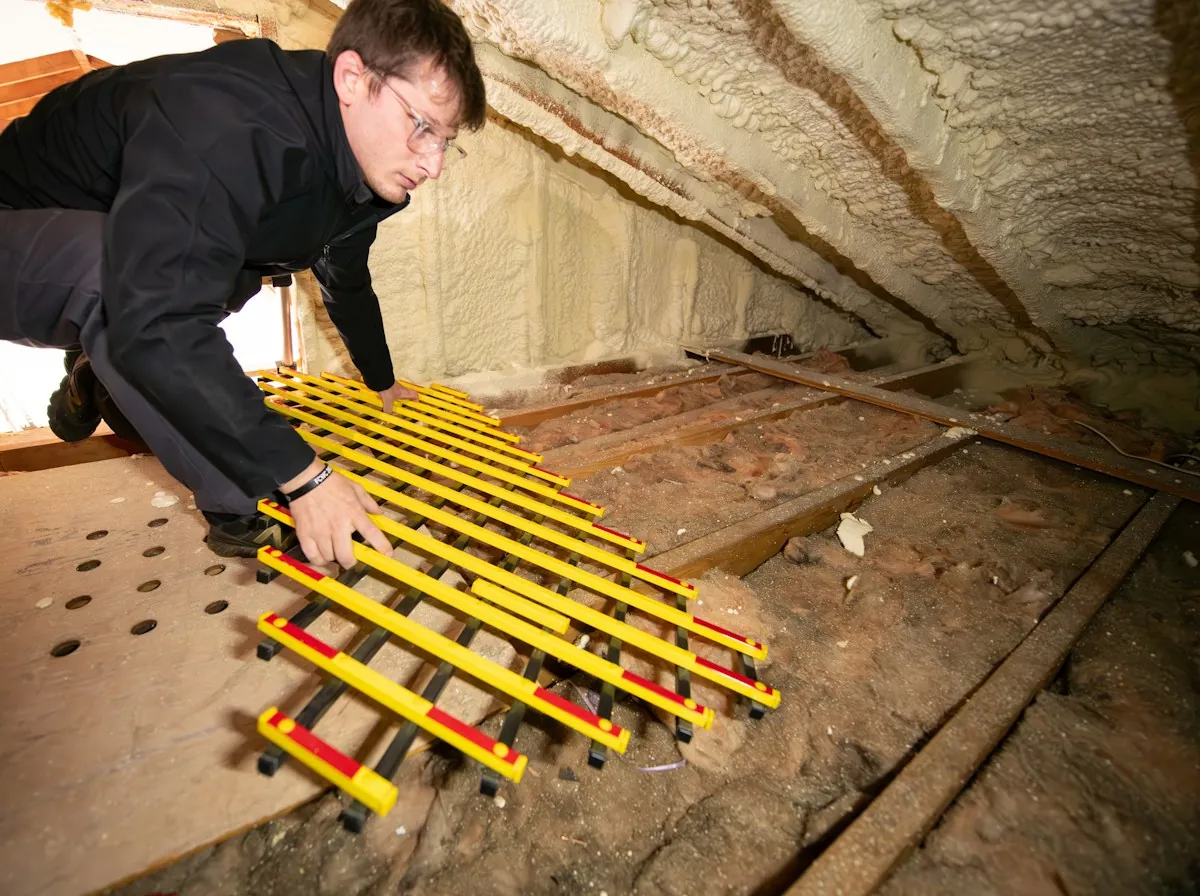
A leak that has already been patched. Tracing water tracking along a rafter takes time in the roof space, and on a shared roof plane it can mean surveying well beyond the unit the water is showing in.
Finding out it is not your roof. That conversation costs nothing and happens on the phone, which is why it is the first thing we ask rather than something discovered after a visit.
A later age-restricted community in the Greenbriar family, built to a more modern standard than the township's first generation of adult communities.
Detached and semi-detached single-story homes on a modern layout, with simpler roof geometry and plywood decking rather than the board sheathing of much older stock.
Newer construction shifts what fails. Decks are sound, coverings are a single layer, and the failures that do appear are at details -- pipe boots, ridge vents, valley intersections -- rather than at the end of a covering's life. Those are cheap repairs when found early.
A newer community is the one place where 'the roof is only twenty years old' is actually a useful thing to know, because the deck under it is not the variable.
In a good part of this township the answer is 'not yours', the date is already scheduled, and you have been paying for it through the monthly assessment.
Outside the communities, a roof is an ordinary private roof and everything below applies to you. Inside Clearbrook, Concordia or Rossmoor, the roof is generally a COMMON ELEMENT the association is obligated to maintain and replace -- not something an owner commissions, and under most governing documents not something an owner is permitted to commission.
An association cannot schedule a repair to something nobody has reported, and a verbal report to a gate house is not a record. This is where an independent survey earns its keep: a photographed written finding is much harder to set aside than a phone call from a resident.
And apply the ordinary tests. Over $500 New Jersey requires the contract in writing and signed, with the legal business name and address on it, and carrying a bold notice giving you three business days to cancel.
On modern construction the genuine emergency is nearly always storm-driven rather than age-driven: something lifted, something struck, something that was fine last week.
On newer roofs detection is quick and usually conclusive, because there are few enough candidate failures to check them all.
Modern low-slope work on newer housing is generally well detailed and correctly fallen, so a leak here is unusual and worth taking seriously as a defect rather than as wear.
Modern skylights in modern roofs, correctly curbed and flashed, which means a leak is usually either a seal reaching the end of its life or, more often, condensation in a well-sealed house with insufficient roof space ventilation..
Two kinds of housing. Whose roof is the question.
A co-operative. The corporation owns the building.
One roof plane, several homes. Scheduled by block.
The leaks are in the additions, not the main roofs.
Detached inside an association. Documents decide.
A separate borough. Private roofs, older stock.
Small roofs, heavy shade, damp close to the lake.
The questions that decide this job, answered up front.
Stop patching and survey the roof space. Water entering at a chimney or a valley can track several feet along a rafter before it shows, so a repair directly above the stain fixes nothing. Two failed patches is strong evidence the entry point was never where the work was done.
Probably not, and you should be glad about that. In a condominium or co-operative the roof is generally a common element the association maintains, so private work on it may mean paying for something your assessment already covers -- and in many governing documents it is not permitted. Ring the management office first; we will survey and write it up if that helps.
Usually not the full term. The rating describes the material under test conditions, not a roof on a particular house, and in this climate freeze and thaw at the eaves, ventilation, drainage and the quality of the original nailing all move the real figure. A 30 year product commonly gives 22 to 27 well-maintained years here. It also matters what happened in year one: a roof nailed badly is on a shorter clock from the day it went on.
Usually not, on a house. Replacing the roof COVERING on a detached one- or two-family dwelling is ordinary maintenance under N.J.A.C. 5:23-2.7 -- no permit, no notice, no inspection. Three or more units, an attached building or anything structural is a different answer. In an association community the binding constraint is usually not the construction office at all, but the governing documents, which are a separate question from the building code.
In New Jersey the question is not the job title, it is the registration. Anyone doing home improvement work on a residence must be registered as a home improvement contractor, and the registration number has to appear on their advertising, their vehicle and any contract. Beyond the paperwork, the practical limit is diagnosis: sealing a visible hole is within most people's reach, and working out that water is entering at a chimney and surfacing two rooms away generally is not.
Whose roof it is established before anything is quoted. A written, photographed report you can hand to a management office.