Roof Leak Detection in Concordia from free with a quote. The stain is not the hole. Finding the entry point is most of the job and all of the value. Free inspection and a written quote.
Where a sunroom or porch meets the main roof, detection is about establishing which side of that junction failed -- and therefore, in a community with owner-added structures, which side of the common element line the work falls on. Those are the same question asked twice.
Water entering at a chimney, a valley or a penetration does not drop straight down. It tracks along the top of a rafter, sometimes several feet, and comes through the ceiling wherever it finds a seam or a fixing. Which is why a repair directly above the stain so often changes nothing.


The inspection is free when attached to a quote, and what follows it is the ordinary repair range -- $350 to $1,800 for most work, from about $150 for something genuinely minor. What you get is the slope, the details that actually fail, the roof space underneath, photographs of anything reported and a written opinion on where the water is entering, written so it can be handed straight to a management office if that is where it needs to go. The pitched roofs are scheduled common-element work; the sunrooms, porches and canopies are where the money and the ambiguity both are. An addition put on by a previous owner may have no date against it in the reserve study and no funding behind it.
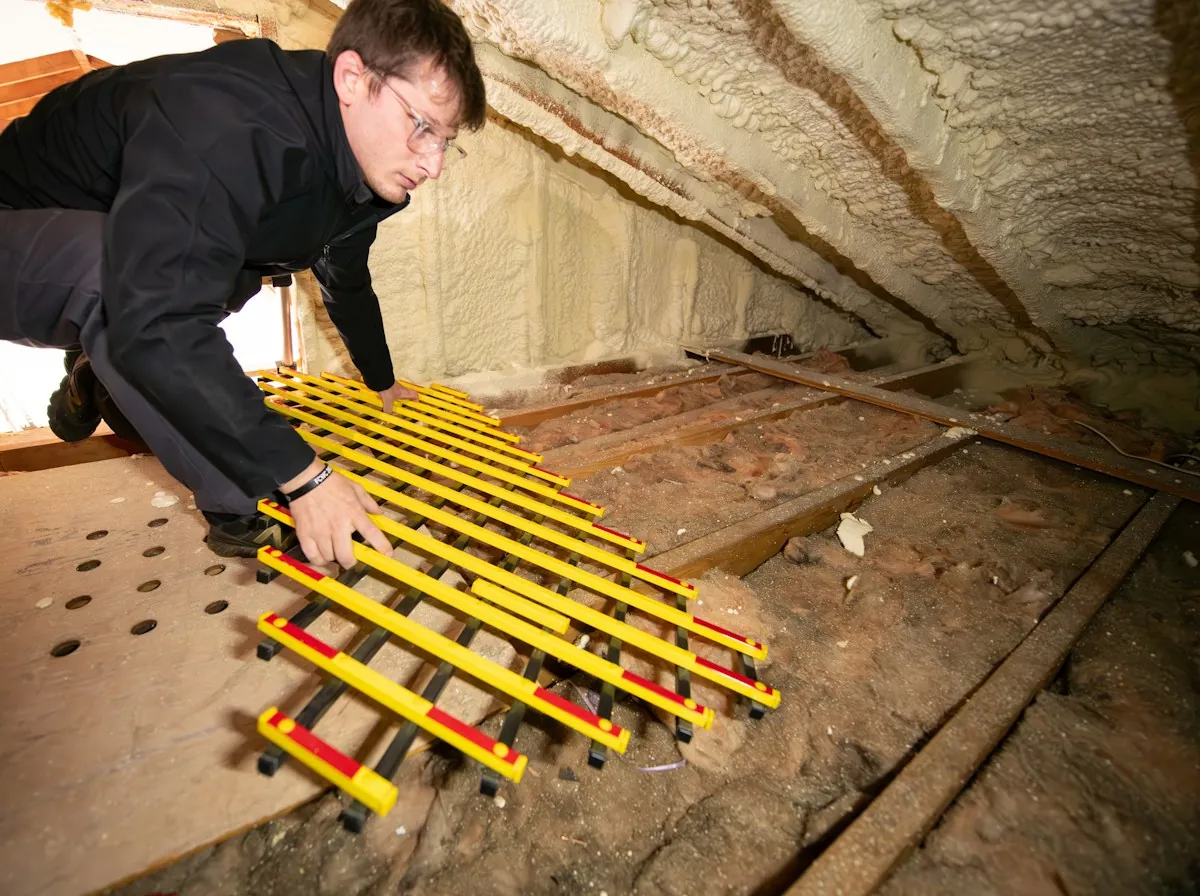
Because the evidence is on the underside: old tracks down a rafter, staining that stops at a nail line, daylight, insulation flattened and dark in one patch. That view is what separates a diagnosis from a guess, and it is what keeps a $350 repair from being spent in the wrong place.
In a community, precisely because we are not the people who will do the work. A photographed, written finding is considerably harder to wave away than a phone call from a resident.
Claim certainty it does not have. Where the evidence is inconclusive, or where a roof space is inaccessible, the report says so rather than implying a completeness it lacks.
The low-slope additions are where the leaks tend to be. Sunroom and porch roofs drain onto or through the pitched roof beside them, the junction is where they fail, and a sunroom added later by a previous owner may sit on a different side of the common element line from the roof it abuts.
Where an addition was made by an owner rather than the builder, who maintains it is a question the governing documents answer and the roof does not.
The first one is the reason a share of our phone calls end with us telling somebody to ring their management office instead.
Not a stain, an entry point. Water runs along a rafter before it shows, so a quote to seal the ceiling side is a quote to do nothing slowly.
Nobody knows how much deck has softened until the covering is off. A rate per sheet is an honest answer; a lump sum is a guess that gets revisited upwards once the roof is open.
The cancellation notice is a legal requirement, not a courtesy. Including it unprompted says somebody expects the quote to survive you thinking about it overnight.
The leaks in Concordia are disproportionately in the low-slope additions -- sunrooms, porches and entrance canopies -- rather than on the main pitched roofs.
A sunroom or porch roof failing in heavy rain is the classic Concordia callout, and it usually goes at the junction with the main roof rather than in the middle.
This is where most of the flat roofing in the community actually is: sunrooms, porches and canopies added onto villa units.
Sun tunnels and skylights in sunrooms and kitchen extensions are common here, and they sit in precisely the low-slope additions that already cause most of the community's leaks.
Two kinds of housing. Whose roof is the question.
A co-operative. The corporation owns the building.
One roof plane, several homes. Scheduled by block.
Newer build. Details fail, not the covering's age.
Detached inside an association. Documents decide.
A separate borough. Private roofs, older stock.
Small roofs, heavy shade, damp close to the lake.
The questions that decide this job, answered up front.
Yes -- that is largely what this is for. You get a written finding naming the entry point and the component that failed, with photographs. It is deliberately specific about WHICH building component, because that is what somebody has to match against the governing documents.
Then the report says so. Some leaks only present under particular wind directions or after prolonged rain and cannot be reproduced on a dry Tuesday. A report that invents a conclusion to justify the visit is worse than one that records what was ruled out.
No. A sound roof does not leak in heavy rain, and treating it as normal is how a small entry point becomes a soft deck. What IS normal is a roof leaking only in certain conditions -- wind-driven rain from one direction, or a long downpour rather than a short one -- because that points at a specific detail failing under specific loading rather than at a hole. It is a diagnosis, not a reassurance.
Usually not the full term. The rating describes the material under test conditions, not a roof on a particular house, and in this climate freeze and thaw at the eaves, ventilation, drainage and the quality of the original nailing all move the real figure. A 30 year product commonly gives 22 to 27 well-maintained years here. It also matters what happened in year one: a roof nailed badly is on a shorter clock from the day it went on.
It is a Florida rule and it does not apply in New Jersey. The 25% rule comes from the Florida Building Code Existing Building, where repairing or replacing more than a quarter of a roof within a year can require the whole thing to be brought up to current code. New Jersey has no equivalent provision. It turns up in searches here because national content repeats it without saying which state it belongs to, and anyone quoting it at you in this state is citing the wrong code book.
Whose roof it is established before anything is quoted. A written, photographed report you can hand to a management office.