Roof Leak Detection in Jamesburg from free with a quote. The stain is not the hole. Finding the entry point is most of the job and all of the value. Free inspection and a written quote.
Older houses make detection harder in one specific way: where there are two coverings, water can travel between them for a considerable distance before reaching the deck. Board sheathing then spreads it again along a board. The roof space is not optional on this stock.
Water entering at a chimney, a valley or a penetration does not drop straight down. It tracks along the top of a rafter, sometimes several feet, and comes through the ceiling wherever it finds a seam or a fixing. Which is why a repair directly above the stain so often changes nothing.


The inspection is free when attached to a quote, and what follows it is the ordinary repair range -- $350 to $1,800 for most work, from about $150 for something genuinely minor. What you get is the slope, the details that actually fail, the roof space underneath, photographs of anything reported and a written opinion on where the water is entering, written so it can be handed straight to a management office if that is where it needs to go. Ordinary private pricing on older borough stock, where two things move the number and neither is visible from the street: how many coverings are already up there, and whether the deck is board or plywood.
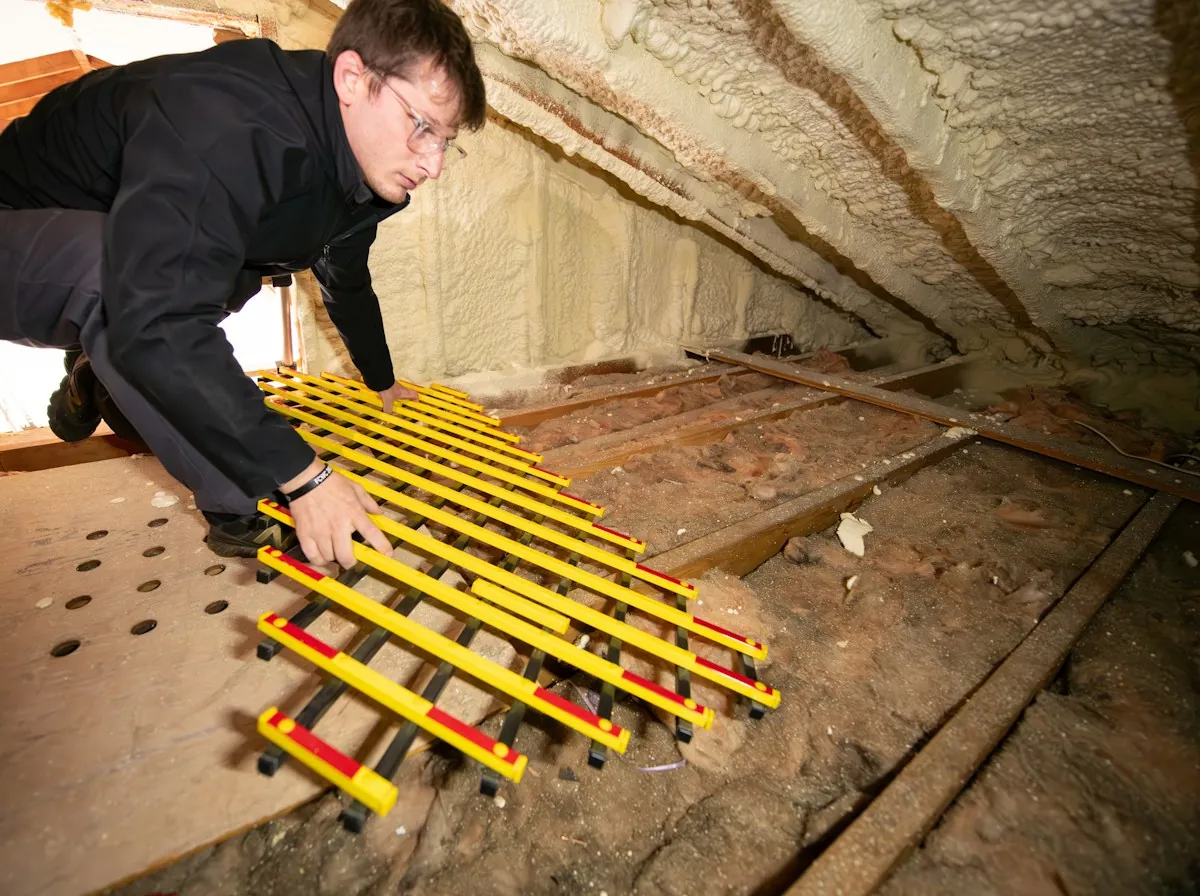
Because the evidence is on the underside: old tracks down a rafter, staining that stops at a nail line, daylight, insulation flattened and dark in one patch. That view is what separates a diagnosis from a guess, and it is what keeps a $350 repair from being spent in the wrong place.
In a community, precisely because we are not the people who will do the work. A photographed, written finding is considerably harder to wave away than a phone call from a resident.
Claim certainty it does not have. Where the evidence is inconclusive, or where a roof space is inaccessible, the report says so rather than implying a completeness it lacks.
The opposite of the rest of this service area: every roof here belongs to whoever owns the house. What matters instead is age and layers -- board sheathing on the older stock, second coverings laid over first ones, and eaves detail that predates any expectation of an ice barrier.
Different borough, different construction office -- and no governing documents to read before starting work.
Worth knowing if you are in a community, where the repair route is longer than a phone call.
Roofs in this part of New Jersey fail at the edges over winter. Water backs up under the courses at the eaves, freezes, lifts them, and the ceiling below stains during the first proper thaw -- which is why the calls arrive in a cluster, in the same two weeks, right across a township at once.
The opposite of the rest of this service area: in Jamesburg every roof belongs to whoever owns the house, there are no documents to read, and a leak is simply a leak.
Older borough housing means an emergency can be an open deck rather than a lifted course, particularly where a second covering has been holding the first one down.
Older borough housing carries flat roofs over rear extensions and porches that in many cases predate modern membranes entirely.
In older housing a skylight is almost always a retrofit, cut into a roof that was not designed for it, sometimes by somebody who framed it themselves.
Two kinds of housing. Whose roof is the question.
A co-operative. The corporation owns the building.
One roof plane, several homes. Scheduled by block.
The leaks are in the additions, not the main roofs.
Newer build. Details fail, not the covering's age.
Detached inside an association. Documents decide.
Small roofs, heavy shade, damp close to the lake.
The questions that decide this job, answered up front.
Yes -- that is largely what this is for. You get a written finding naming the entry point and the component that failed, with photographs. It is deliberately specific about WHICH building component, because that is what somebody has to match against the governing documents.
Then the report says so. Some leaks only present under particular wind directions or after prolonged rain and cannot be reproduced on a dry Tuesday. A report that invents a conclusion to justify the visit is worse than one that records what was ruled out.
It is a Florida rule and it does not apply in New Jersey. The 25% rule comes from the Florida Building Code Existing Building, where repairing or replacing more than a quarter of a roof within a year can require the whole thing to be brought up to current code. New Jersey has no equivalent provision. It turns up in searches here because national content repeats it without saying which state it belongs to, and anyone quoting it at you in this state is citing the wrong code book.
In New Jersey the question is not the job title, it is the registration. Anyone doing home improvement work on a residence must be registered as a home improvement contractor, and the registration number has to appear on their advertising, their vehicle and any contract. Beyond the paperwork, the practical limit is diagnosis: sealing a visible hole is within most people's reach, and working out that water is entering at a chimney and surfacing two rooms away generally is not.
Most leak repairs in this market run $350 to $1,800, with genuinely minor work from about $150. The wide spread is because it covers two different jobs: putting right a failure you can see, and finding one you cannot. If a quote is at the top of that range, the thing to ask is what it includes by way of actually locating the entry point, because that is where the work is.
Whose roof it is established before anything is quoted. A written, photographed report you can hand to a management office.