Roof Leak Detection in Rossmoor from free with a quote. The stain is not the hole. Finding the entry point is most of the job and all of the value. Free inspection and a written quote.
This is the single most useful thing an independent contractor can do in a co-operative, precisely because we are not the people who will do the work. A written, photographed opinion on where water is entering is something a resident can hand to the management office, and it is much harder to wave away than a phone call.
Water entering at a chimney, a valley or a penetration does not drop straight down. It tracks along the top of a rafter, sometimes several feet, and comes through the ceiling wherever it finds a seam or a fixing. Which is why a repair directly above the stain so often changes nothing.


The inspection is free when attached to a quote, and what follows it is the ordinary repair range -- $350 to $1,800 for most work, from about $150 for something genuinely minor. What you get is the slope, the details that actually fail, the roof space underneath, photographs of anything reported and a written opinion on where the water is entering, written so it can be handed straight to a management office if that is where it needs to go. Co-operative ownership makes this the clearest case in the service area: the corporation owns the building and maintains the roof phase by phase from reserves. The only work reasonably priced to a resident here is interior, or a survey written to be handed on.
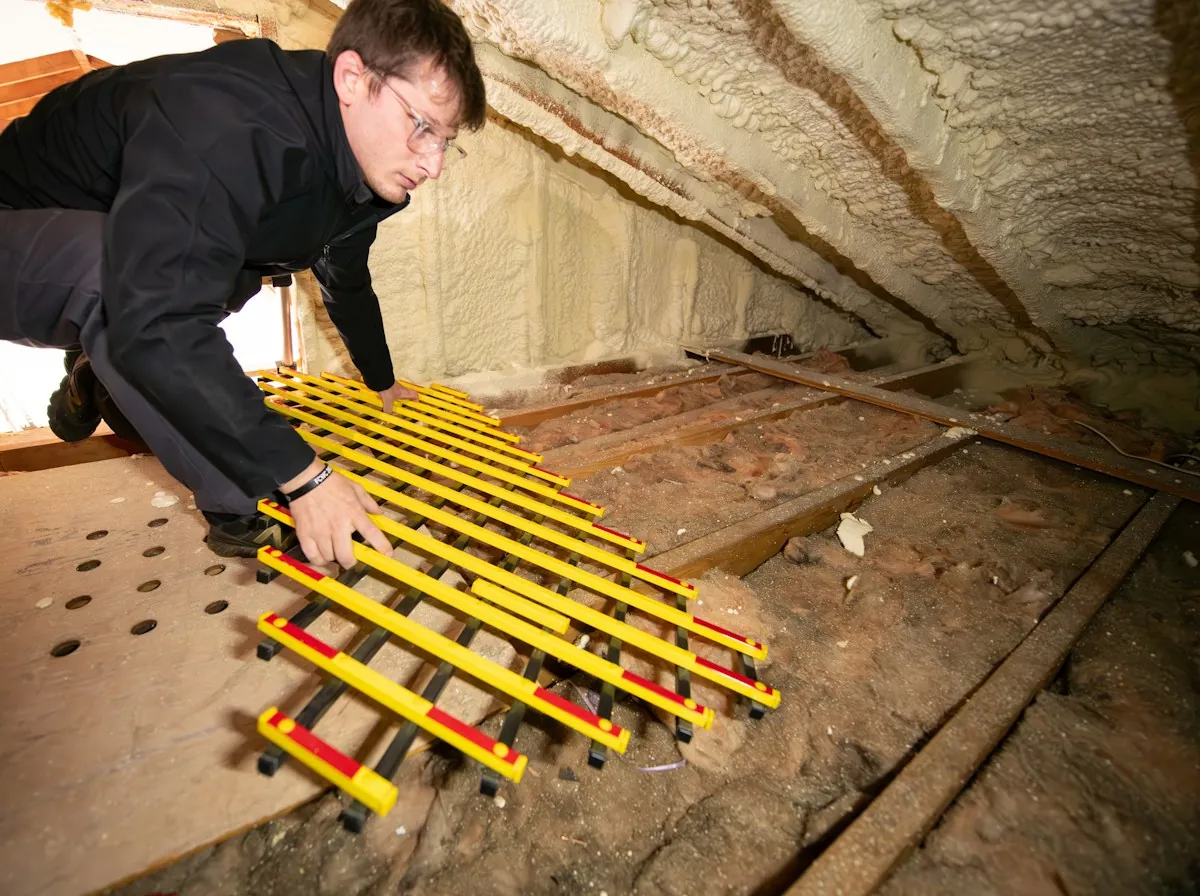
Because the evidence is on the underside: old tracks down a rafter, staining that stops at a nail line, daylight, insulation flattened and dark in one patch. That view is what separates a diagnosis from a guess, and it is what keeps a $350 repair from being spent in the wrong place.
In a community, precisely because we are not the people who will do the work. A photographed, written finding is considerably harder to wave away than a phone call from a resident.
Claim certainty it does not have. Where the evidence is inconclusive, or where a roof space is inaccessible, the report says so rather than implying a completeness it lacks.
Under a co-operative, the corporation owns the building and a resident holds shares and a proprietary lease. The roof is about as clearly not an individual's to replace as it is possible to be, and private work on it is the wrong route in almost every case.
Age alone says very little here -- units were built in phases across a long period, and phases were re-roofed separately.
The first one is the reason a share of our phone calls end with us telling somebody to ring their management office instead.
Not a stain, an entry point. Water runs along a rafter before it shows, so a quote to seal the ceiling side is a quote to do nothing slowly.
Nobody knows how much deck has softened until the covering is off. A rate per sheet is an honest answer; a lump sum is a guess that gets revisited upwards once the roof is open.
The cancellation notice is a legal requirement, not a courtesy. Including it unprompted says somebody expects the quote to survive you thinking about it overnight.
Rossmoor is a CO-OPERATIVE, which puts this about as far from a private repair as roofing gets: the corporation owns the building and a resident holds shares and a proprietary lease.
In a co-operative the emergency call goes two ways: somebody stops the water, and the management office is told that a building component has failed.
Flat sections over entrances and walkways in a co-operative are unambiguously the corporation's, and generally maintained on a schedule.
A skylight in a co-operative is a penetration through a roof the corporation owns, which makes it one of the clearest cases for reporting rather than arranging.
Two kinds of housing. Whose roof is the question.
One roof plane, several homes. Scheduled by block.
The leaks are in the additions, not the main roofs.
Newer build. Details fail, not the covering's age.
Detached inside an association. Documents decide.
A separate borough. Private roofs, older stock.
Small roofs, heavy shade, damp close to the lake.
The questions that decide this job, answered up front.
Yes -- that is largely what this is for. You get a written finding naming the entry point and the component that failed, with photographs. It is deliberately specific about WHICH building component, because that is what somebody has to match against the governing documents.
Then the report says so. Some leaks only present under particular wind directions or after prolonged rain and cannot be reproduced on a dry Tuesday. A report that invents a conclusion to justify the visit is worse than one that records what was ruled out.
Most leak repairs in this market run $350 to $1,800, with genuinely minor work from about $150. The wide spread is because it covers two different jobs: putting right a failure you can see, and finding one you cannot. If a quote is at the top of that range, the thing to ask is what it includes by way of actually locating the entry point, because that is where the work is.
One with a single identifiable entry point, no sign of the water having been getting in for long, and a sound deck underneath -- a split pipe boot, a lifted course, a length of flashing that has come away. Those are same-day repairs at the bottom of the range. A leak stops being minor when the deck has softened, when it has been tracking long enough to stain more than one place, or when it has already been patched and come back.
Usually not the full term. The rating describes the material under test conditions, not a roof on a particular house, and in this climate freeze and thaw at the eaves, ventilation, drainage and the quality of the original nailing all move the real figure. A 30 year product commonly gives 22 to 27 well-maintained years here. It also matters what happened in year one: a roof nailed badly is on a shorter clock from the day it went on.
Whose roof it is established before anything is quoted. A written, photographed report you can hand to a management office.